


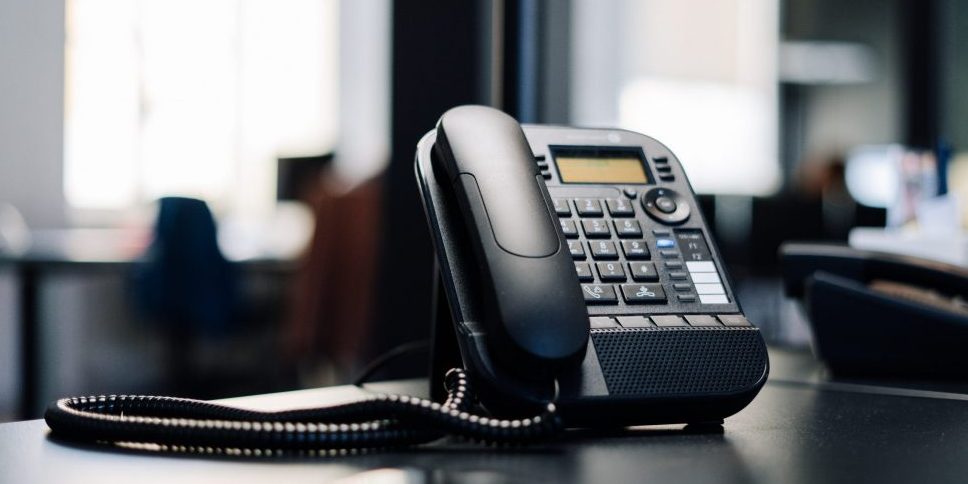
Curious about VoIP and why so many are switching?? Our experts are here to break it down for you – what VoiP is, how VoIP works, and why it’s a smarter way to stay connected.
Plus, we’ll show you how Airband Talk makes it simple to pair VoIP with your broadband.
- What is VoIP?
- Brief History of VoIP
- How does VoIP work?
- What are the technical requirements for VoIP calls?
- Benefits of using broadband and VoIP
- The future of VoIP and broadband
- What is WiFi calling?
- Can I get VoIP with Airband?
What is VoIP?
VoIP stands for Voice over Internet Protocol – put simply, it lets you make and receive calls over your broadband instead of a traditional phone line. That means a future proof phone connection, and no more paying line rental.
Brief History of VoIP
Originating as a US Department of Defense experiment in 1973, VoIP has since become a staple in modern communication, boasting features that traditional phone systems can’t rival.
1970s – The first experiments
The concept of sending voice as data started in 1973, when researchers working on ARPANET (the predecessor to the internet, funded by the US Department of Defense) created experimental protocols to transmit voice signals across a packet-switched network.
1980s – Early developments
Through the 1980s, universities and research labs continued exploring how to digitise voice and send it over computer networks. The idea was promising but limited by slow internet speeds and high equipment costs.
1990s – Commercial beginnings
The first consumer-facing VoIP services appeared in the mid-90s. Companies like VocalTec launched products such as “InternetPhone”, which let users make calls between computers, using dial-up connections. Call quality was patchy and headsets were bulky, but it proved that voice over the internet was possible.
2000s – Broadband changes the game
As broadband internet became widespread, VoIP moved from niche tech to mainstream. Companies like Skype made free or low-cost internet calling accessible to millions worldwide. Businesses began switching from traditional PBX phone systems to IP-based systems to cut costs and gain flexibility.
2010s – Mobile and enterprise adoption
The growth of smartphones and faster mobile data made VoIP portable. Apps like WhatsApp, Viber, and Zoom integrated VoIP into everyday life, while enterprise solutions such as Cisco and Microsoft Teams made it standard in workplaces.
Today – The new normal
Now, VoIP underpins much of global communication. It’s a foundation for unified communications, remote collaboration, and even customer service systems. With advances like 5G and AI on the horizon, VoIP is set to become even more seamless, reliable, and feature-rich.
How does VoIP work?
Traditional phone networks rely on circuit switching – when you make a call, a dedicated line is created between you and the person on the other end.
VoIP works differently.Your voice is converted into small packets of digital data, which travel across the internet (like emails or web pages) and are reassembled into a clear conversation at the other end.
What are the technical requirements for VoIP calls?
- Bandwidth: A smooth VoIP call experience requires a certain minimum bandwidth – however, a single standard-quality call only uses around 100kbps, which is tiny compared to activities like streaming video..
- Internet speeds: If you’re using VoIP for voice calls, a modest internet connection is fine. If you’re using VoIP for video or conference calls, faster speeds are recommended – but even our 40Mbps fixed wireless broadband will be more than sufficient for this.
- Upload and download balance: Many people focus on download speeds, but for VoIP, upload speed is just as important. Clear, two-way communication relies on both directions working well. All our fibre broadband packages offer equal upload and download speeds.
Find out more: What is a good download and upload speed?
Benefits of using broadband and VoIP
Switching to VoIP comes with a host of advantages over traditional landline services – from lower costs to smarter features that make everyday communication easier.
Call costs
Calls made over VoIP are often much cheaper than those made on traditional landlines – especially long-distance or international calls – and many VoIP packages, including Airband Talk, offer unlimited local and national calls. For many households and businesses, this can add up to significant savings.
One supplier, one bill
With VoIP and broadband combined, you only need one supplier for both voice and data. This means simpler billing, fewer contracts to juggle, and streamlined support if you ever need help.
Future-proof phone service
Traditional copper phone lines are scheduled to be phased out by 2027, meaning all households and businesses will need to switch to digital services. With VoIP, you’ll be ahead of the curve.
The future of VoIP and broadband
Technology never stands still, and VoIP is no exception. As broadband speeds increase and digital tools become more advanced, VoIP is set to play an even bigger role in how we connect – at home, at work, and on the move. Here are some of the key trends shaping the future of VoIP:
1. AI integration
Artificial Intelligence (AI) is expected to play a significant role in enhancing VoIP services. From smarter virtual assistants to predictive analytics that can improve call quality in real-time, the synergy between AI and VoIP will drive efficiency and user experience.
2. Enhanced mobility
With the rise of remote work and digital nomadism, VoIP services will focus on offering more mobile-friendly solutions, ensuring seamless communication regardless of location.
3. Integration with smart devices and IoT
As the Internet of Things (IoT) expands, VoIP will connect more than just people. From smart home assistants to workplace devices, VoIP will become a backbone for seamless voice-enabled interactions across all kinds of connected tech.
4. Stronger security and privacy
With cyber threats on the rise, future VoIP services will place a bigger focus on encryption, authentication, and fraud prevention. Expect built-in tools that protect conversations and data.
What is WiFi calling?
WiFi calling is a feature offered by mobile networks that lets you make and receive calls using a WiFi connection instead of relying on a mobile signal. It’s especially useful in areas where mobile coverage is weak but WiFi is strong – for example, in rural locations or inside buildings with poor reception. From the user’s point of view, nothing changes: you dial as normal, and the call goes through your WiFi rather than the mobile network.
Is it the same as VoIP?
Not quite – but they’re closely related.
- VoIP (Voice over Internet Protocol) is the underlying technology that makes it possible to send voice as digital data over the internet. Services like Skype, Zoom, and Airband Talk are all forms of VoIP.
- WiFi Calling is essentially a type of VoIP, but tied directly to your mobile provider. It uses your existing phone number, contacts, and billing, so you don’t need a separate app or account.
So, while all WiFi calling relies on VoIP technology, not all VoIP services are WiFi calling. The main difference is that VoIP can be provided by any service (independent of your mobile network), whereas WiFi calling is built into your mobile operator’s system.
Why do I need VoIP if I have WiFi Calling?
WiFi calling is a handy mobile feature, but it’s limited to your mobile network and device. VoIP, on the other hand, is a full phone service that works across multiple devices, offers cheaper calls, advanced features, and is the future replacement for landlines.
Can I get VoIP with Airband?
Yes, you can get a VoIP service on a broadband connection with us.
At Airband we provide a VoIP service named “Airband Talk” with all of our broadband packages. You can add an Airband Talk package onto your current package for a small fee per month.
Contact our sales team by phone to learn more about our VoIP and broadband packages, or sign up to Airband Talk here.
Related Articles
Check availability: